
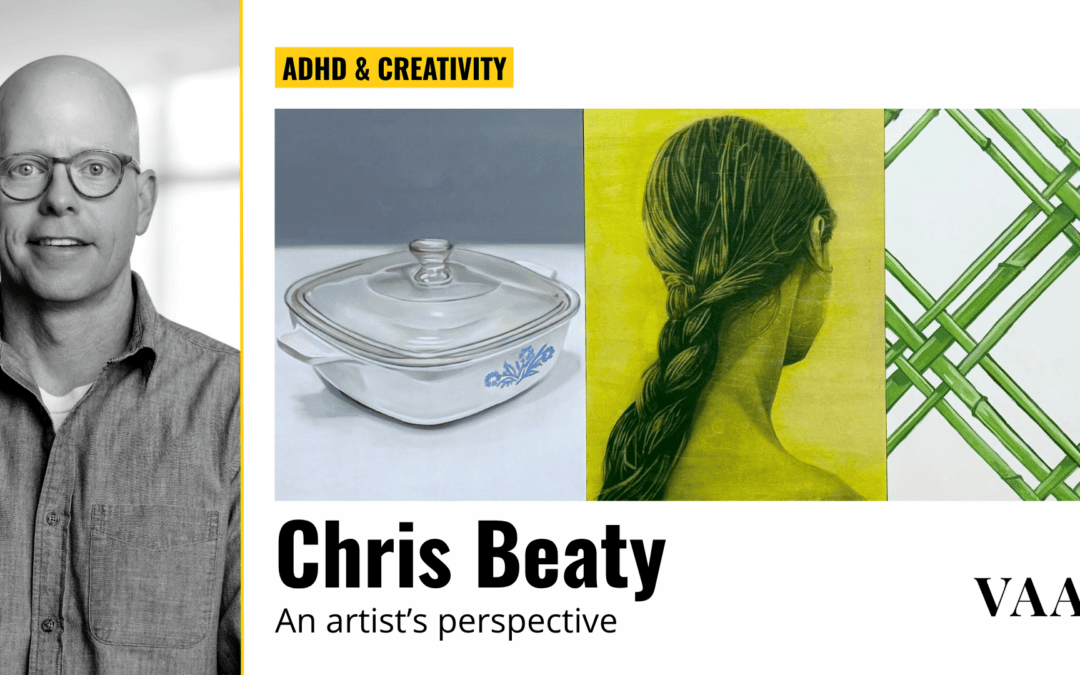
For ADHD Awareness Month, Chicago-based artist Chris Beaty talks about attention, memory and the unexpected connections that shape his work.
In a prior VAA article about ADHD and creativity, we explored some of the challenges and misconceptions that can accompany a neurodivergent creative life. Artist Chris Beaty reached out after reading it and shared how strongly it resonated with him
For ADHD Awareness Month, we wanted to continue that conversation through Chris’s experience. A multidisciplinary artist based in Chicago, he works primarily in painting and drawing.
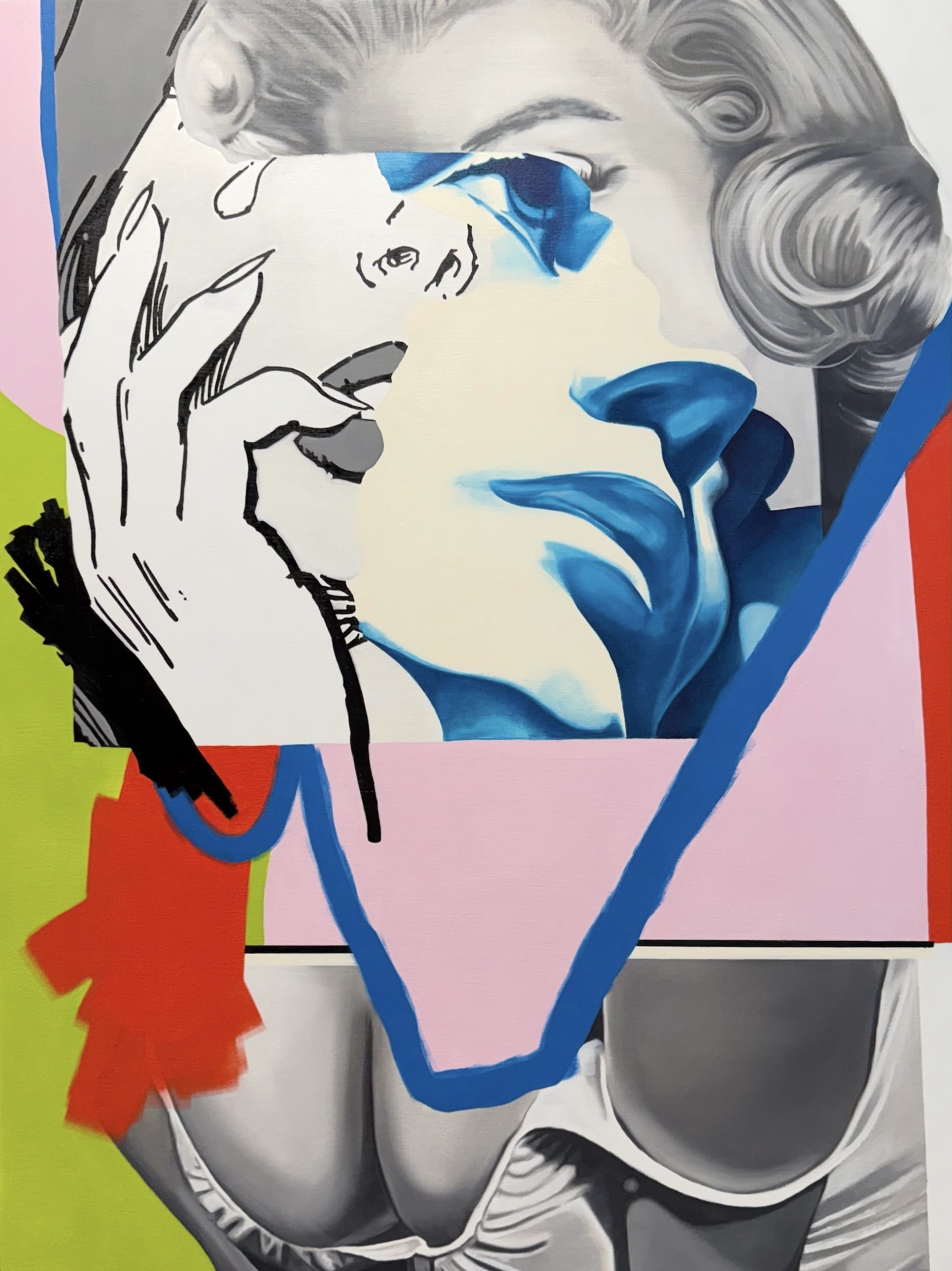
His collage-inspired compositions bring images, memories and associations together, reflecting the way his attention moves between them.
Chris is equally open about the difficulties ADHD can bring.
In this interview, he discusses the challenge of starting and finishing work, the joy of becoming absorbed in a painting, and why he resists calling ADHD a “superpower”.
Seeing the world with ADHD
ADHD Awareness Month often focuses on the challenges associated with ADHD. What do you wish more people understood about the experience of being a creative person with ADHD?
I think one of the biggest things I wish people understood is that ADHD isn’t simply a deficit or something that needs to be overcome.
In fact, I don’t really think “attention deficit” is an accurate way to describe my experience.
My attention isn’t necessarily lacking; it can actually feel like there is too much competing for it. My attention can be pulled toward seemingly unrelated images, details, ideas, sounds, or observations, sometimes all at once.
For me, that influences the way I see the world, make connections, and approach my artwork. Those seemingly unrelated images, details, and ideas often become the starting points for my paintings and drawings.
At the same time, the challenges are real. Regulating my attention, managing time, and bringing an idea to completion can be difficult, even when I’m passionate about the work. But I don’t see ADHD as a limitation on my creativity.
It is simply part of how my mind works. It influences what I notice, the connections I make, the questions I ask, and ultimately how I experience the world and make my art.
IMAGE: Starlets and Saints 2025 Chris Beaty
From an idea to a finished painting
How does ADHD show up in your creative process, from the first spark of an idea through to a finished artwork?
Getting started is often the hardest part of my creative process. I can have so many ideas competing for my attention that deciding which one to pursue first can become overwhelming. That difficulty with decision-making, which I associate with executive function challenges, can sometimes feel paralysing.
Once I finally begin working, however, I can enter a state of flow or hyperfocus relatively quickly. Hours can pass in what feels like the blink of an eye. During these periods, I become completely absorbed in the work, and interruptions can be particularly frustrating because they pull me out of that concentration and momentum.
There are also times when I begin to lose interest in a painting. Sometimes that is simply boredom, and sometimes a new idea has captured my attention.
Rather than always fighting that tendency, I’ve learned to use it to my advantage. I often keep several works in progress at once, so if I become frustrated or bored with one painting, I can move to another and return to the first later with fresh eyes.
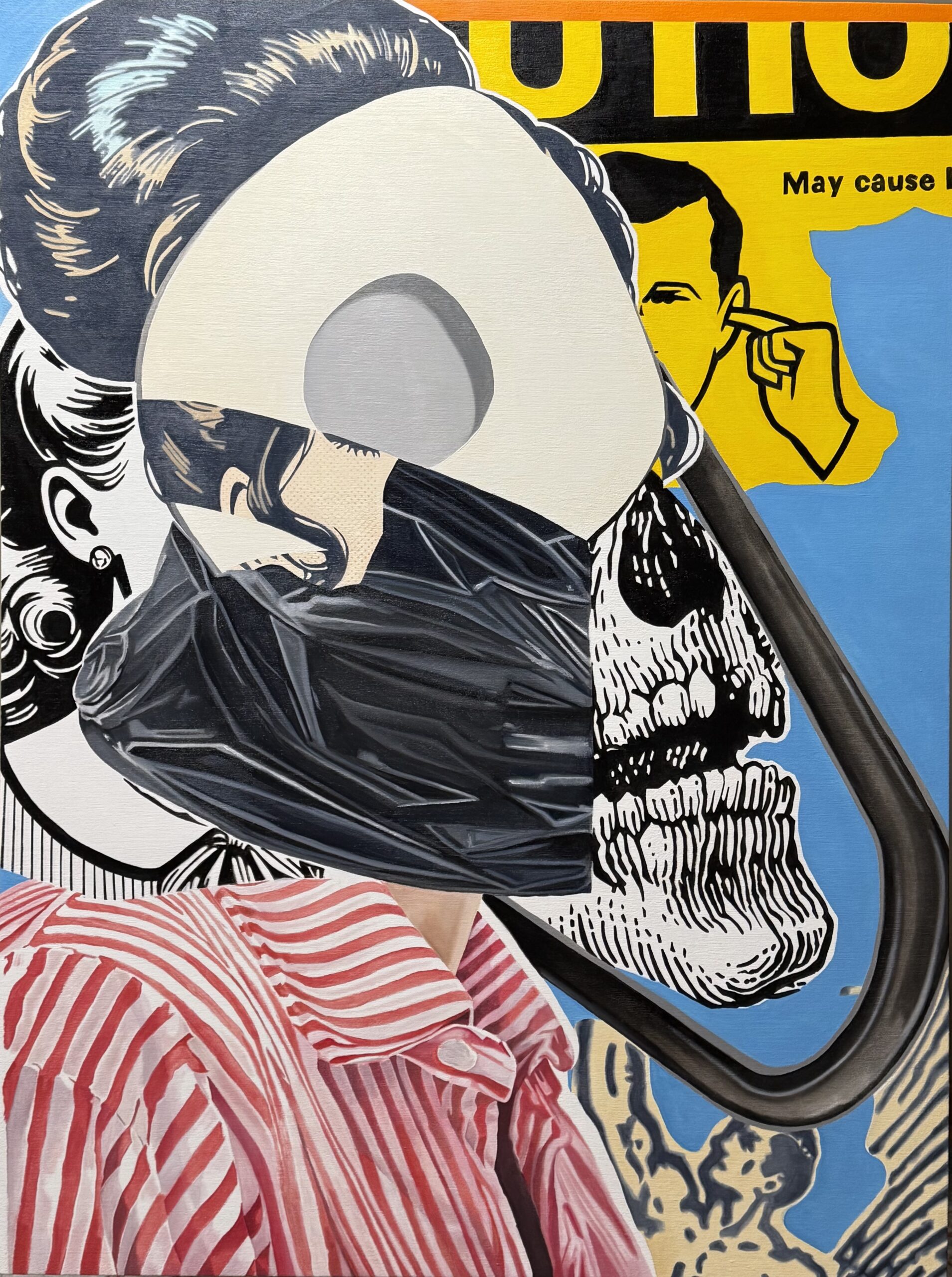
The way I work also lends itself to this kind of shifting attention. My paintings often have a collage-like structure, with different images and fragments interacting with one another. If I become tired of a particular subject or feel that it is no longer working, I can rethink it, alter it, or introduce something new.
So the same tendency that can make it difficult to stay focused can also become part of the creative process itself.
IMAGE: Nothing to See/Hear 2025 Chris Beaty
Knowing when a painting is finished
Getting to the finished work used to be one of my biggest challenges. While I was in graduate school, I really struggled with knowing when a piece was finished and having the confidence to actually call it finished. My indecisiveness and lack of self-confidence often made it difficult to commit to a final decision. This is something I have had to consciously work on, and it is still a work in progress. I’m learning that finishing a painting requires not only knowing when to make changes, but also having the confidence to eventually stop and let the work exist on its own.
Where unexpected connections meet
ADHD minds can sometimes make unexpected connections between seemingly unrelated ideas. Does this happen in your practice?
Ha, I think you just described everything I create.
It can be difficult to explain to someone who thinks in a linear way what it feels like for me to live with ADHD. My thoughts don’t always travel down one clearly defined road. They take side roads.
A small detail in an image might remind me of an object from childhood. That memory might lead to another image, which leads to a colour, a person, a place, or an entirely different memory. Each connection opens another road.
From the outside, those connections might seem unrelated or even distracting.
To me, they are part of the way I experience the world. I don’t always know where a particular thought is going to lead, and I don’t necessarily need to.
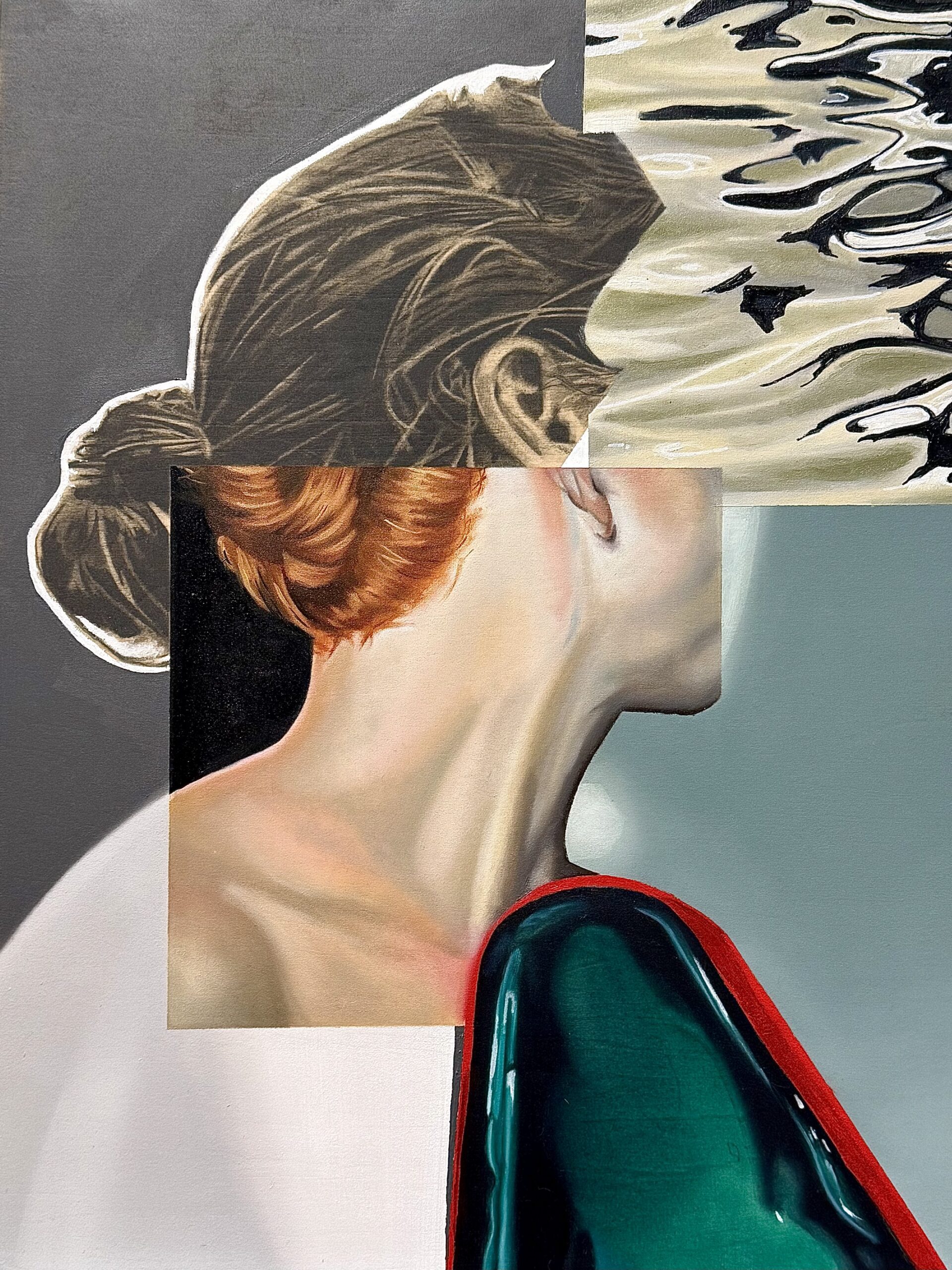
In some ways, the canvas becomes the place where those side roads can finally meet. Images and memories that might not have an obvious relationship can exist together on the same surface.
The canvas becomes a kind of home for the things my mind has gathered along the way.
IMAGE: Untitled (Redhead) 2025 Chris Beaty
Finding a way of learning that fits
Can you remember a moment when something you had always struggled with because of ADHD unexpectedly became an advantage in your creative practice?
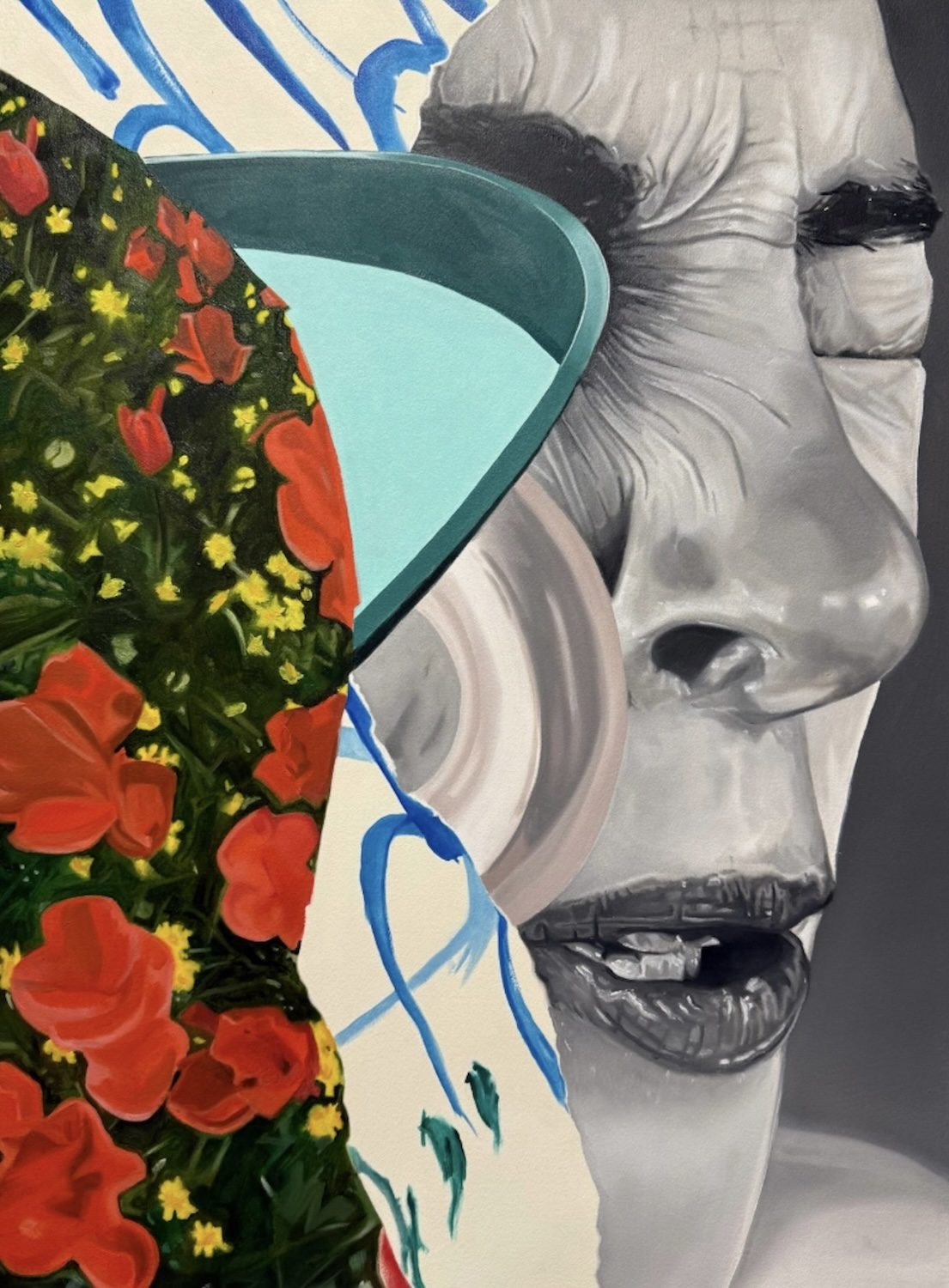
I think one of the biggest examples has been learning to recognise the value in the way my mind naturally works. Traditional learning environments often rely on a one-size-fits-all structure. For much of my life, I struggled in those environments because my attention and way of processing information didn’t always fit within those expectations.
When I decided to leave my career as a firefighter and return to school to pursue a career in art, I honestly wasn’t sure if I could do it. School had always been such a struggle for me. But once I entered the art studio, something changed. The structure of the studio and the mentorship of professors such as Justin Henry Miller and Laurie Hogin were a perfect fit for the way I learn and think.
I could become completely absorbed in a project. I could follow an idea down a rabbit hole, ask questions, experiment, change direction, and spend hours working through a problem. There wasn’t always a single prescribed way to get from the beginning of an assignment to the end. I was given room to explore, and that made a tremendous difference for me.
For the first time, I began to realise that maybe I wasn’t incapable of learning. Years later, and now more knowledgeable about ADHD, I am aware that I had simply been trying to learn within systems that didn’t work particularly well for the way my mind works.
Returning to school ultimately changed much more than my career. It changed the way I understood myself as a learner and, eventually, as an artist.
IMAGE: Surreal Bloom 2025 Chris Beaty
One image leads to another
Is there a particular artwork that you feel captures something about the way your ADHD mind works? What should we look for when viewing it?
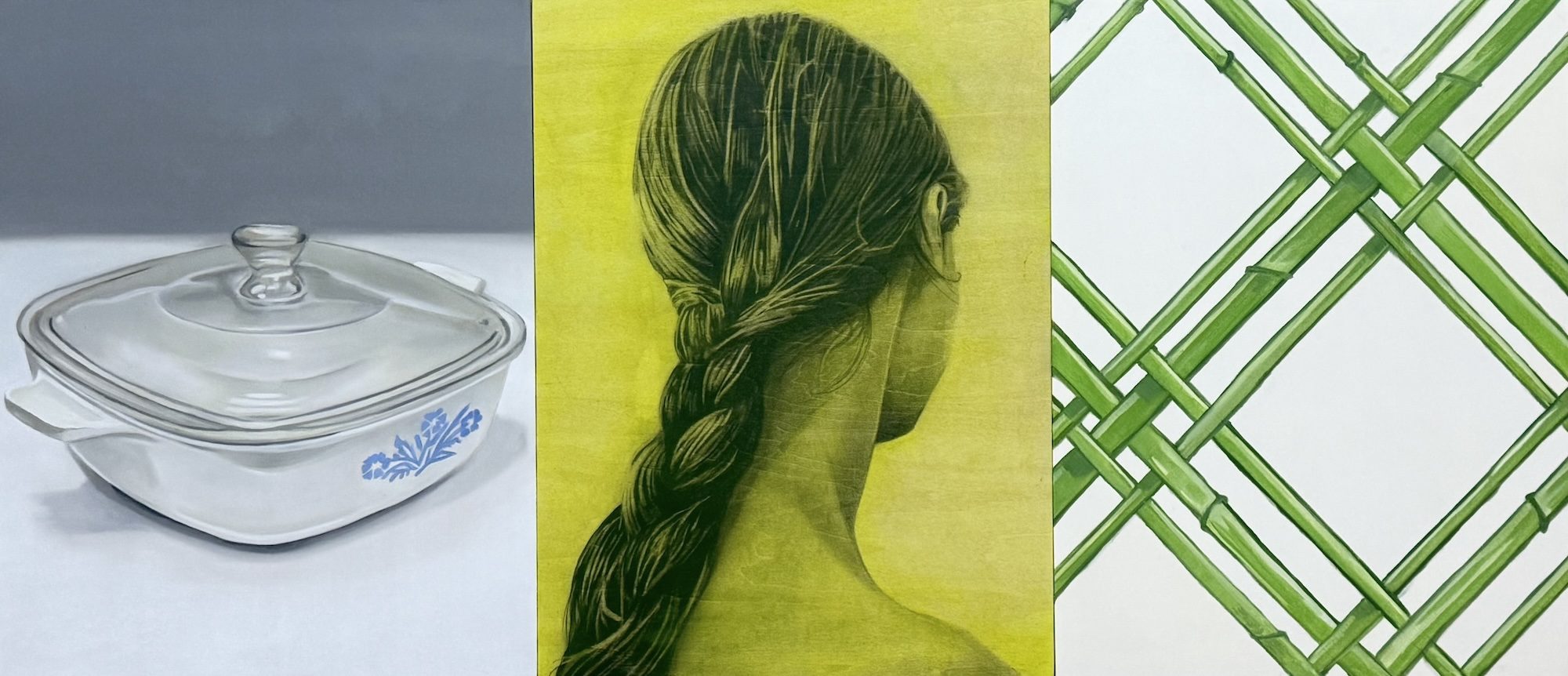
IMAGE: Corningware and Yellow Braid 2026 Chris Beaty
I think the series of work I am working on right now is a good example of how my memories tend to work. I might start thinking about an object from my childhood, like a CorningWare dish that we ate endless casseroles from. That one image can lead me down a whole series of memories. I might think about the food, the kitchen, the house, and eventually remember something as seemingly insignificant as the wallpaper pattern on the walls.
That’s often how my mind works. One image leads to another, and then another, and I can end up somewhere I never intended to go when I started. The connections aren’t always logical, but they are connected in my memory.
The paintings I’m working on now grew out of that kind of chain of associations. I think there’s something nostalgic about the imagery that may resonate with a lot of viewers. But I’m also interested in how something as ordinary as a dish or a wallpaper pattern can become loaded with memory and meaning. When looking at the painting, I’d want people to notice those connections, or perhaps more importantly, to make their own connections. I’m not interested in giving the viewer one specific story to follow. I’d rather the images trigger something in their experiences and allow their memories to start making connections of their own.
Why “ADHD is a superpower” misses the point
If you could challenge one misconception about ADHD and creativity this ADHD Awareness Month, what would it be?
I hear podcasters and influencers say that ADHD is a “superpower”. ADHD may come with some advantages for a creative mind, such as hyperfocus, making unexpected connections, thinking nonlinearly, or having what seems like an endless stream of ideas. I’ve experienced those things myself, and I value them, but they are only part of the story.
ADHD can also make a lot of everyday life much more difficult. I have no idea what it feels like to have a neurotypical brain, so I can only speak from my own experience.
For me, executive function difficulties can make seemingly simple tasks feel overwhelming or even paralysing.
So, yes, there may be aspects of ADHD that can benefit my creative practice. But calling it a “superpower” can minimise the very real challenges that come with it. I find the term dismissive because it focuses on the perceived advantages while overlooking how difficult ADHD can actually make everyday life.
I’d rather talk about ADHD as something I’m learning to understand and work with: recognising both the strengths and the difficulties rather than turning it into a catchy, positive, and trendy label.
IMAGE: Channel Surfing 2025 Chris Beaty
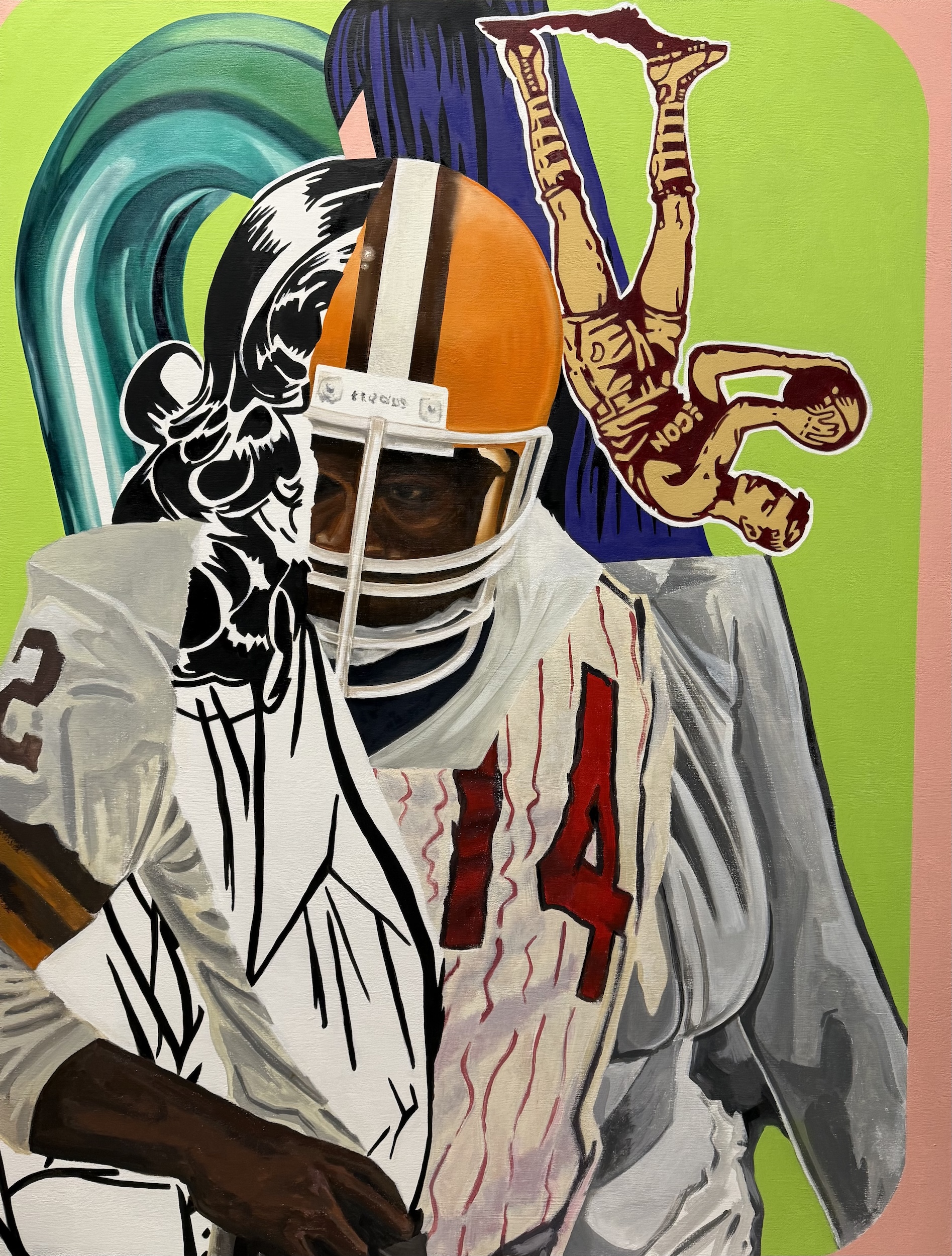
What Chris would tell his younger self
If you could speak to your younger self, before you understood your ADHD brain, what would you want him to know?
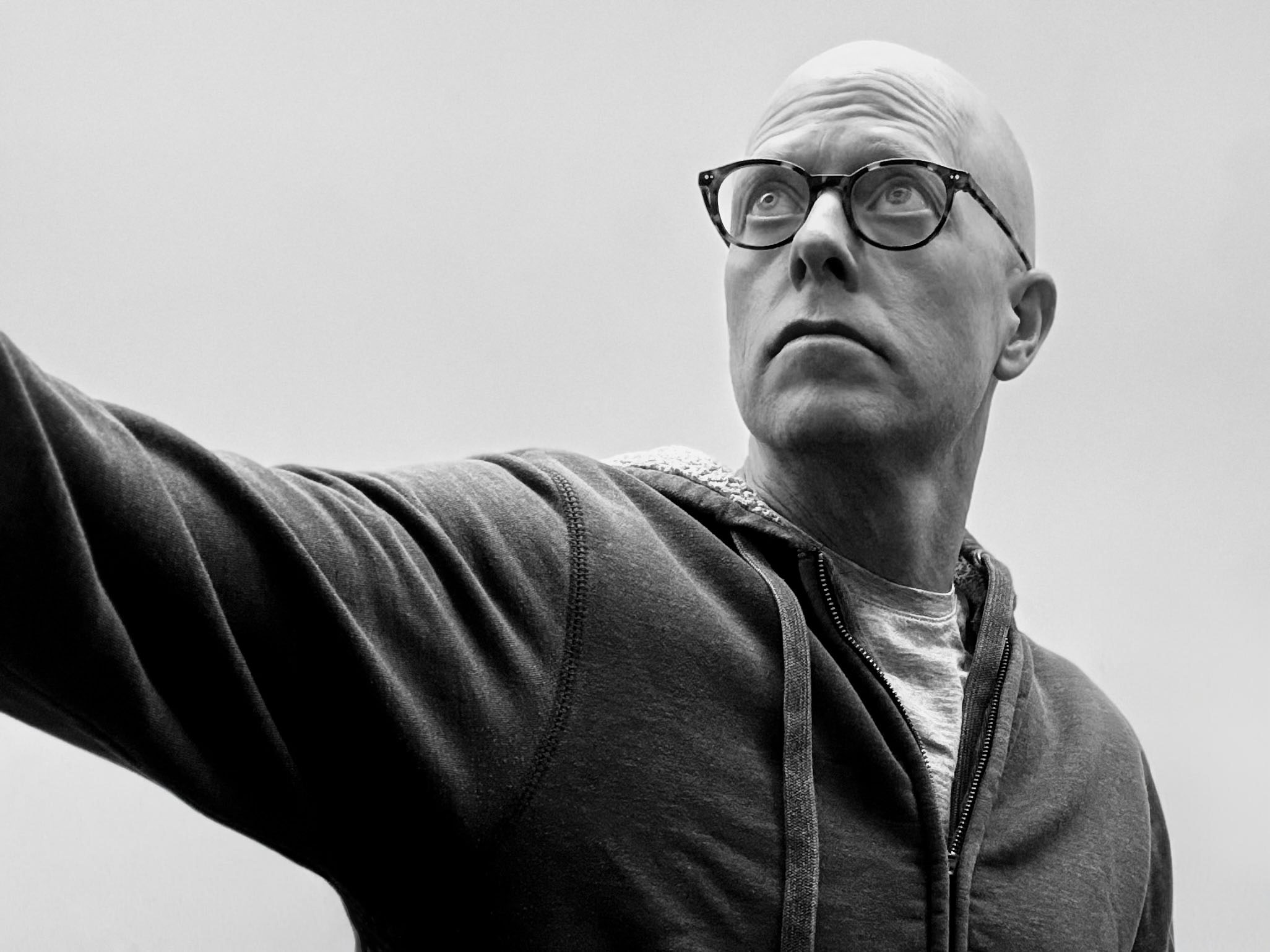
I would tell my younger self that he doesn’t have to spend his life trying so hard to be like everyone else. For years, I heard the same things over and over again: “Be quiet.” “Pay attention.” “Focus.” “Sit still.” “If you would just apply yourself…” I heard those messages so often that I began to believe there was something wrong with me. I didn’t understand why I could become completely absorbed in something I cared about, yet struggle so much with things that didn’t capture my attention. Because I wasn’t diagnosed with ADHD until later in life, I spent years interpreting those struggles as personal failures. I became very good at masking, watching the people around me and adjusting my behaviour so I wouldn’t stand out.
I would tell the younger Chris that the things that make him different aren’t necessarily things that need to be hidden. One day, he’ll discover that some of those very things will become part of his voice as an artist. Understanding my ADHD has helped me stop trying so hard to fit someone else’s expectations and start paying attention to who I actually am.
“I’m not sure who that person would be”
Finally, we asked Chris whether there was anything about the way he thinks or creates that he would be afraid of losing if he woke up without ADHD
Wow. That is a fantastic, and terrifying question. I honestly don’t think I’ve ever thought about it.
Short answer: I would be terrified. I’m not sure who that person would be.
Long answer: Sure, I would want to lose some of the difficulties of ADHD, but I wouldn’t want to lose the person I’ve become while learning to live with it. I’ve spent so much of my life thinking I needed to fix the way my brain worked that I’m finally learning I don’t have to be at war with myself.
I think I’d be afraid of losing the things that make my mind my own, such as the way I make connections, the constant stream of ideas, and the ability to become completely absorbed in subjects that capture my attention.
Those things have become part of how I experience the world, and ultimately, part of how I make art.
As I’ve gotten older and learned more about my ADHD, I’ve also learned to accept and love myself, including the quirky ways my brain works, the struggles, the frustrations, and even some of the unexpected ways I think and create.
This is the way I know myself. I’ve adapted to it, and it works for me now. I’m still learning how to work with my ADHD and overcome its challenges, but I no longer feel like I need to become someone else in order to do that.
A personal reflection from Sarah Birkenhead, VAA Digital Marketing Executive
“I’m finally learning I don’t have to be at war with myself.”
Reading Chris’s words brought tears to my eyes. I recognised so much of my own ADHD journey in his answers, especially that feeling of being at war with yourself, and of not quite belonging. I spent 15 years in the beauty industry, but I never felt I had found my place. For a long time, I felt broken. I struggled to understand why things that seemed straightforward for other people could feel so difficult for me.
Much like Chris, I received my ADHD diagnosis later in life and changed career paths. That change led me towards work that makes me incredibly happy. My role in digital marketing gives my ideas somewhere to land. Working in the art industry has introduced me to people whose experiences resonate deeply with my own. I can finally say I have found my people, and an outlet.
Through their stories, I recognise familiar challenges and internal battles. There is something deeply reassuring about discovering that other people have travelled a similar path.
Giving our ideas somewhere to land
Working in the art industry, I have met many people with ADHD who find an outlet in creativity, professionally or as a hobby. For many of us, that outlet matters. It gives the ideas circling in our minds somewhere to go, whether through painting, drawing, writing or bringing a new idea to life.
There can be so much care behind that energy. We care deeply about the things that matter to us. Some might say too much, and sometimes it can feel overwhelming. But when something captures our attention and we feel passionate about it, we can pour ourselves wholeheartedly into it. Chris’s answers remind us how meaningful it can be to find an outlet that makes room for that part of who we are.
Sharing these stories can also give us a sense of purpose: the chance to help someone feel seen, understood or less alone. Even a small moment of connection can leave the world a little better than we found it.
Chris’s experience is his own, and ADHD will look and feel different for everyone. His openness reminds us that understanding ourselves can mean acknowledging the challenges, finding ways of working that fit and making room for the unexpected connections that shape our ideas. We are grateful to Chris for sharing both his work and the personal journey behind it.
About Chris Beaty
Chris Beaty is a multidisciplinary artist based in Chicago, Illinois. A former firefighter, he earned his MFA from the University of Illinois in 2020. Alongside his painting and drawing practice, he teaches studio art courses as an adjunct professor in the Chicagoland area.
If you would like to discover more of Chris’s amazing work, visit chrisbeatyart.com or follow him on Instagram at @chrisbeatyart.