

The start of a new year carries a particular charge for creatives. There is optimism, certainly – a sense of possibility, a feeling that something might shift. But there is also pressure. The quiet insistence that this should be the year things finally fall into place. Your goals should be clearer. That progress should be visible.
For artists and creative professionals, goal-setting is rarely straightforward. Creative lives do not unfold in tidy increments. They evolve through intuition, doubt, persistence and long stretches of unseen labour. And yet January has a way of inviting reflection. It creates a pause; a psychological threshold; that allows us to step back and ask what is worth carrying forward, and what might need to change.
There is a good reason why this moment feels powerful. Research shows that we are more open to changing habits at meaningful points in time, moments that feel like a reset. A new year creates distance from old patterns and offers permission to begin again. The challenge for creatives is resisting the idea that a fresh start requires dramatic reinvention, rather than careful adjustment.
At the VAA, this tension is familiar. Year after year, artists arrive in January full of ambition, but also with questions about pace, focus, and sustainability. The most sustainable progress rarely comes from sweeping resolutions. Instead, it grows from smaller, deliberate shifts: clearer focus, more realistic pacing, and habits that support creativity rather than drain it.
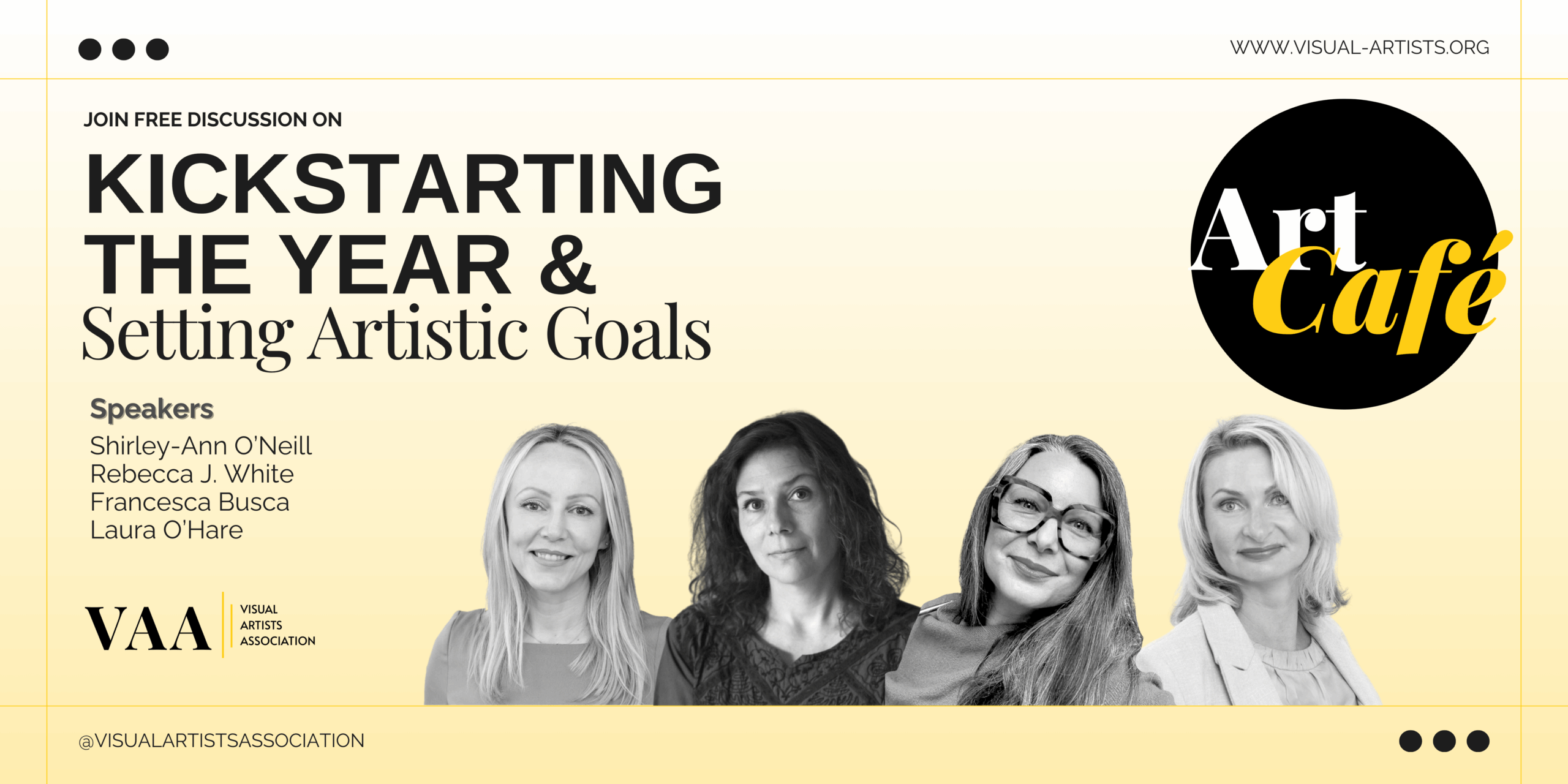
These themes sat at the heart of Art Café: Kickstarting the Year & Setting Artistic Goals, a live online conversation chaired by Laura O’Hare, and featuring eco-artist Francesca Busca, painter Rebecca J. White, and VAA founder Shirley-Ann O’Neill. Rather than offering formulas for success, the discussion unfolded as a reflection on how artists build sustainable momentum — not just in January, but over years.
What emerged was a shared belief that a fresh start does not require frenzy. It requires clarity.
Francesca Busca’s practice is expansive by nature. Since 2017 she has developed a distinctive form of waste-based mosaic, transforming discarded materials into intricate works she calls “trashure” – pieces that function both as visual delight and environmental protest. Her work sits at the intersection of art, activism and environmental advocacy, challenging ideas of value and consumption not only in content, but in method.
She exhibits internationally, collaborates with universities, works in public art and remains deeply engaged in environmental networks. On paper, it looks like a practice in constant motion. In reality, it is held together by careful choice.
“I like to do a bit of everything,” she says, “but timing is what really decides. Once I commit, I don’t step back – I give two hundred percent. So before committing, I check my calendar, I make sure I really have the time, and I leave some space for things that might come up.”
In a creative landscape saturated with open calls, residencies and opportunities, that pause is crucial. For Busca, focus is not about narrowing ambition, but about alignment.
“I filter very clearly,” she explains. “I wouldn’t go into a group show that’s not aligned with eco-artivism or with people I feel truly connected to. That’s how I stay focused – by staying in my niche.”

That clarity is supported by structure – something Busca feels comfortable with after a former career as a city solicitor.
“Structure is very natural to me,” she reflects. “Now that I finally do what I was born to do, structure actually helps me enjoy it more.”
Rather than stifling creativity, structure creates space.
“I work backwards from what I want to achieve and plan the steps,” she says. “But I always schedule a buffer day, a flex day, because there are days when you just can’t do it.”
That buffer is not indulgent.
“If you force it, it takes three times longer and doesn’t feel right. So I take that day off, completely guilt-free, because I know it will make me better afterwards.”
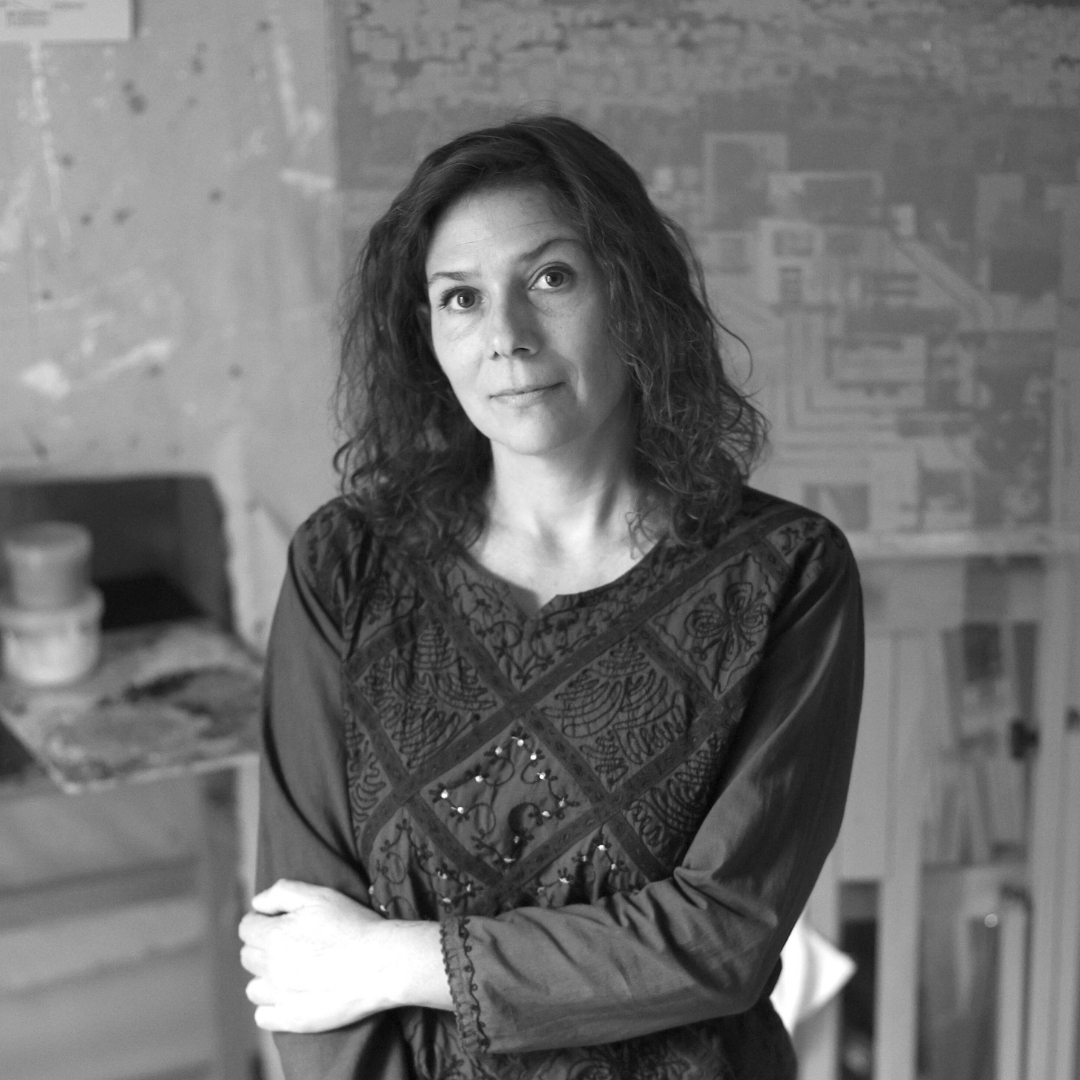
Rebecca J. White’s practice offers another perspective on longevity. An American painter with over 25 years of studio practice, her work draws on visual systems inspired by electronic circuitry, shaped by years living and working across Japan, Italy and the United States. Where Busca’s work is expansive in scope, White’s is anchored in continuity.
“At this point, I stay focused on one solo exhibition a year,” she says. “There’s a lot of noise and opportunity around, but I want more time for practice and less pressure from exhibitions that are expensive and time-consuming.”
This narrowing is not a retreat. It is a way of protecting attention.
In the studio, White works within clear parameters. She structures her work in long-running series and insists on finishing every piece she begins. When frustration arises; as it inevitably does; she shifts laterally rather than stopping altogether.
“I usually have several works going at once,” she explains. “If I’m frustrated with one, I move to another. That keeps me flowing rather than blocked.”
Her commitment is daily, but deliberately modest.
“I’m in my studio every day; but that doesn’t mean twelve hours of painting. Sometimes it’s just touching the work, making a small mark, or even looking at it. But I can’t walk through my front door without interacting with my work. That’s how I stay connected.”
What both artists share is an understanding that momentum does not come from force. It comes from return.
From her vantage point, supporting artists over decades, Shirley-Ann O’Neill sees the same pressures surface each January. Ambition is rarely the issue. Direction is. “There are lots of shiny pennies out there,” she says. “New opportunities, new platforms, new ways to sell or show your work. And it’s very easy to get distracted by all of them.”
Her advice begins with a simple question. “Does this support my practice? Does it support my well-being? And does it support my long-term direction?” she asks. “Or is it just keeping me busy?”
O’Neill is direct about one of the most damaging myths artists absorb early on. “Productivity doesn’t equal value,” she says. “Sometimes you have to go slow to go fast.” When artists feel anxious about their goals, she treats that anxiety as information rather than a problem to overcome. “If a goal makes you anxious, it usually needs reframing,” she explains. “That’s often because it’s too big, too vague, or too far away.”

Her solution is deliberately modest. “Make your goals smaller than you think they need to be,” she says. “Small wins create momentum. And momentum builds confidence.” Rather than endless to-do lists, she encourages artists to identify a handful of meaningful priorities. “I often suggest choosing one clear intention and one major milestone per quarter,” she says. “If you can look back at the end of the year and say you moved four important boulders, that’s real progress.”
Equally important, she adds, is learning how to recognise progress along the way. “Celebrating small wins matters,” she says. “It might be a good studio session, a meaningful conversation, or simply showing up when it felt difficult.”
Across the conversation, one idea surfaced again and again: timing matters.
“I truly believe timing matters,” says Busca. “Sometimes when things aren’t working, it’s not because you’re wrong, it’s because it’s not the moment yet.”
When that happens, she steps back rather than pushing harder.
“I look at what life is asking of me right now. Maybe that’s what needs my attention instead. Don’t force it. Be ready – but don’t push.”
O’Neill sees this perspective as essential for long-term resilience. “Doubt and uncertainty are part of the territory,” she says. “If creativity is part of who you are – not just something you do; you’re far more likely to stay committed when things feel uncertain.”
Not everyone will understand that choice. “You have to surround yourself with people who understand what you’re trying to build,” she adds, “and accept that not everyone will.” And disappointment, she believes, often carries useful information. “Sometimes disappointment just means there’s a better opportunity is coming,” she says. “Not everything that doesn’t work out is a rejection. Sometimes it’s redirection or needs reframing to gain perspective.”
As the conversation drew to a close, the focus returned to the year ahead, and how artists might begin it without overwhelming themselves.
“Clarity and certainty often come from taking action, not waiting,” O’Neill says.
Busca agrees. “Be truthful to yourself,” she says. “Look honestly at what you have, what you want, and what you actually have time for. It’s better to do less and do it very well than to do everything badly.”
And White offers perhaps the simplest grounding of all. “For me, art is like faith,” she says. “It’s not something separate from who I am. So I need to build my life in a way that supports it.”
In a season that often demands reinvention, these artists offer something steadier: patience, attention, and trust in the long game. A fresh start does not require a dramatic change. It does not ask for bigger goals or louder declarations.
Instead, it asks for honesty, and for small, sustainable steps taken with care.
To hear the full conversation and explore these ideas in more depth, you can watch the Art Café panel discussion Kickstarting the Year & Setting Artistic Goals on demand here.
The Visual Artists Association also offers a practical Artist Goal Planner, designed to help you plan with clarity and confidence. Members can access the guide here. To become a member of the VAA, head here.