Artist Breakthrough Moments | In Conversation with Vidushi Gupta
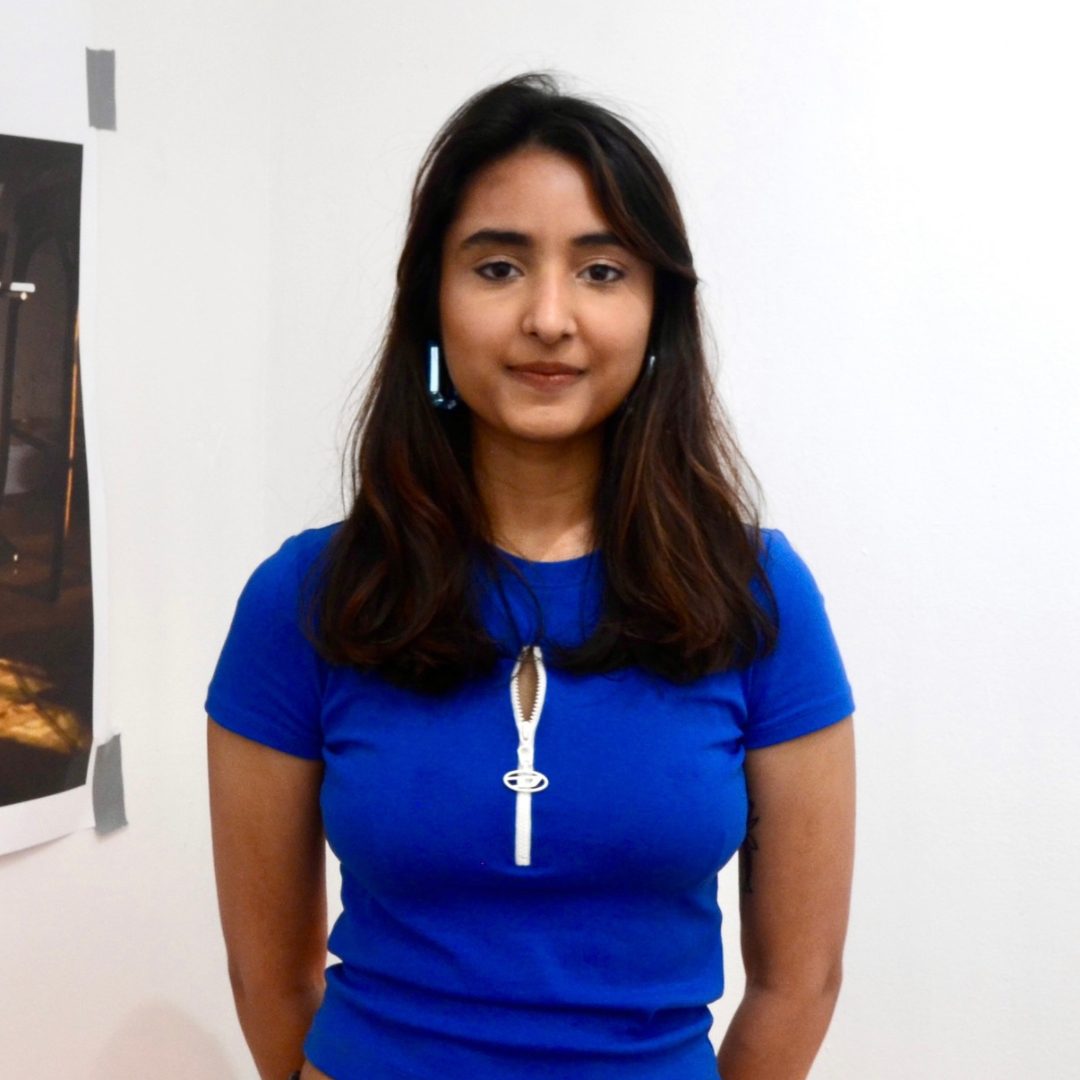
The VAA recently sat down with Vidushi Gupta to discuss her artwork, creative process and recent mentorship with Shirley-Ann O’Neil.
Vidushi began as a painter creating action-based, all-over compositions, driven by gesture and movement. Her artwork has since evolved into a practice rooted in abstract surrealism.
Colour plays a central role in Vidushi’s work. Research conducted at Yale on colour theory, prompted Vidushi to experiment with colour as a structural and conceptual base rather than relying on traditional systems of shadow and form. This shift allowed colour to function as both subject and method within Vidushi’s paintings.
Vidushi gradually expanded beyond paint as her primary medium through university research and extensive museum engagement. As a result, Vidushi has worked with a range of materials and objects drawn from everyday life. This has enabled her to express fleeting moments, encounters, and experience through physical means. Vidushi’s practice is deeply informed by phenomenology, with a particular interest in the idea of “after-ness” – the residue of experience, action, and presence that lingers beyond the moment itself.
Keep up to date with Vidushi’s work: @zinc0912
I remember feeling bored in what was partly a study room and partly a storage room in my house, filled with knick-knacks and a window perfectly placed for the afternoon sun to pass through. One afternoon, when I was not in school, I watched the sunlight create colours through a sheer curtain. It was a quiet moment of boredom, solitude, and observation.
That room became the place where I brought newly discovered paints, newspapers, and cardboard to make things. I would read books on science experiments and try them out, and spend time with colouring books. I think about this period often, as it feels essential for me to stay connected to boredom and play, especially after the advent of technology and the demands of adult life. Returning to moments of observation remains important to my practice.
Drawing and painting, and more technical approaches to art, were not so much about confidence with the tool or learning a grip, but about observations demanding an urgent place of expression.
What was your journey into art like – was there a person, place, or experience that motivated you to create art?
“Art comes from within, in connection with the other”. Your paintings are guided by the subconscious and makes use of colour, movement and form to transform reality introspectively. What feelings or emotions do you aim to evoke in your audience? How do you want people to respond to your artwork?
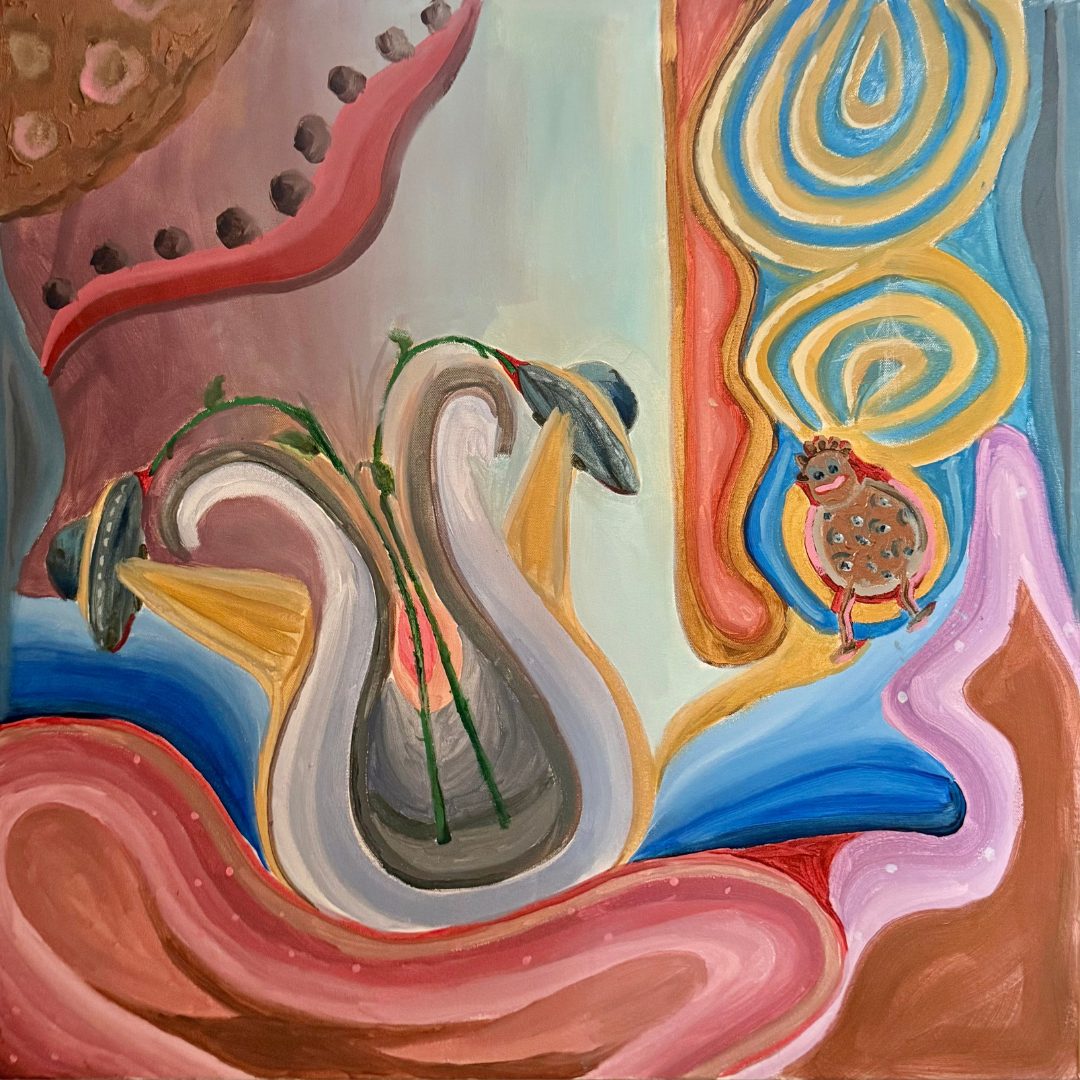
What I want the audience to feel is ultimately irrelevant to me. I see my paintings as individual beings, and I often wonder what a painting is if both the artist and the viewer are removed. Perhaps it becomes an object in storage, stacked among others, yet still different from them.
I believe in accidents, events, and situations. A viewer encounters a painting in my studio, a gallery, or someone’s home, and an event takes place in that moment of confrontation. What they feel, or choose not to feel, becomes another event altogether, one I would never know unless it is later articulated. When someone speaks about a gesture or a perceived symbolism, that articulation itself becomes an event for me.
Meaning-making seems like a protective mechanism, a way to deny the possibility that the work might not have a purpose. Yet I enjoy playing with this idea, because whatever meaning I give a painting inevitably shifts as the work moves through different spaces and contexts, even personal life events. Before meaning existed, however, there was an encounter between colour, brush, and canvas. It is this initial moment of encounter that I remain most interested in.
I
consider Bridge to Barren a learning lesson within my practice. Like many of my works, it began with an encounter. I noticed a crushed Coca-Cola can on the road that had taken on the texture of the surface beneath it. Its bright red colour caught my attention. It was an object that had fulfilled its function of holding a drink and was now flattened, stuck to the road, and seemingly out of circulation.
I photographed the can and brought the image into my studio. However, Coca-Cola is an object heavily charged with meaning, and my research quickly shifted toward the environmental damage caused by the company. What began as a quiet interest in the after-ness of an object turned into a feeling of shock and despair. With that shift, my usual approach also changed, and the work began to move toward a more explicitly political direction. I found myself thinking that artists are expected to be political.
I started collecting discarded cans from the streets and removing their branding, which became an act that felt aggressive in itself. The red dust from the sanding process became part of a globe-like structure, while the stripped cans formed a pillar. I was interested in creating a sense of otherworldly weight, empty and crushed cans holding up a larger structure. In the globe, I played with ideas of physical and emotional weight, reflecting the heaviness I experienced while researching Coca-Cola and its impact.
I am unsure whether I would choose another object so heavily weighted with existing meaning to explore ideas of functionality again. While I recognise the importance of political work, I am more drawn to open-ended encounters with my surroundings, where interpretation is not fixed and meaning is allowed to remain unresolved.
What was your creative process like for your mixed-media installation, Bridge to Barren? How does an idea evolve into a final piece?

As a graduate from the Royal College of Art and the University of the Arts London, what advice would you give to art students and graduates who want to break into the industry?

Universities are, at the end of the day, another capitalist body operating within a larger capitalist system. That said, they do offer some important things. They bring a large number of great artists into the same room committed to dialogue and exchange of ideas. Having mentors can be helpful as well but for me, the most valuable lesson was learning how to take advice that resonated with me and more importantly leaving behind what did not. One of the most impactful encounters I had with a mentor involved very little instruction. They simply said, “Don’t try to make art, let it happen.” This was during my undergrad, when the pressure to constantly produce work felt especially intense. Being given permission not to make art, despite being in an environment structured around output, completely shifted my approach. It brought me back to observation and patience, allowing work to emerge rather than forcing it.
University also introduced me to peers who continue to shape my practice beyond the institution. For example, an artist and art therapist friend and I organised an art wellbeing workshop during my exhibition. Working together allowed both our practices to expand and flourish in ways that would not have happened in isolation. I continue to plan similar projects with other artists, not simply because we shared a university experience, but because I genuinely admire and connect with their practices.
That being said, universities are not the only places where meaningful artistic communities form. Historically, artists gathered in cafés in Paris or Soho in London, and today similar exchanges still happen at exhibition openings and informal café meetups. Recently, when visiting graduate shows, I have often found that smaller institutions present stronger, more considered exhibitions than larger cohorts. This has reinforced my belief that scale and prestige do not necessarily correlate with quality or depth of practice, and that smaller cohorts often benefit more from genuine collaboration.
While universities may help polish a CV and language around a practice, sustaining an artistic career depends far more on commitment, relationships, and learning to trust one’s own rhythm.
Shirley-Ann and I connected through a shared belief that creativity exists in all of us, and that what people often need most is space and support to access it. As a writer working with similar ideas, she offered me valuable guidance on developing my art wellbeing book.
Our conversations also extended to the practical realities of sustaining a practice. We spoke about the importance of visibility, regular exhibitions, and how to approach these thoughtfully. She shared relevant open calls I could apply for, which helped me see concrete pathways forward rather than abstract possibilities. Together, this helped me clarify my short-term and long-term goals and hold them with clarity rather than pressure as well as some tools for putting them into practice.
Shirley’s belief in uplifting creative individuals, and her generosity in sharing knowledge, is something the art world deeply needs, and I am very grateful to have met her and continue to be guided by her perspective.
You recently completed your mentorship with Shirley-Ann O’Neill – in what ways has having a mentor positively impacted your art and artistic process?

Do you have a piece of artwork that is particularly significant to you? And why?
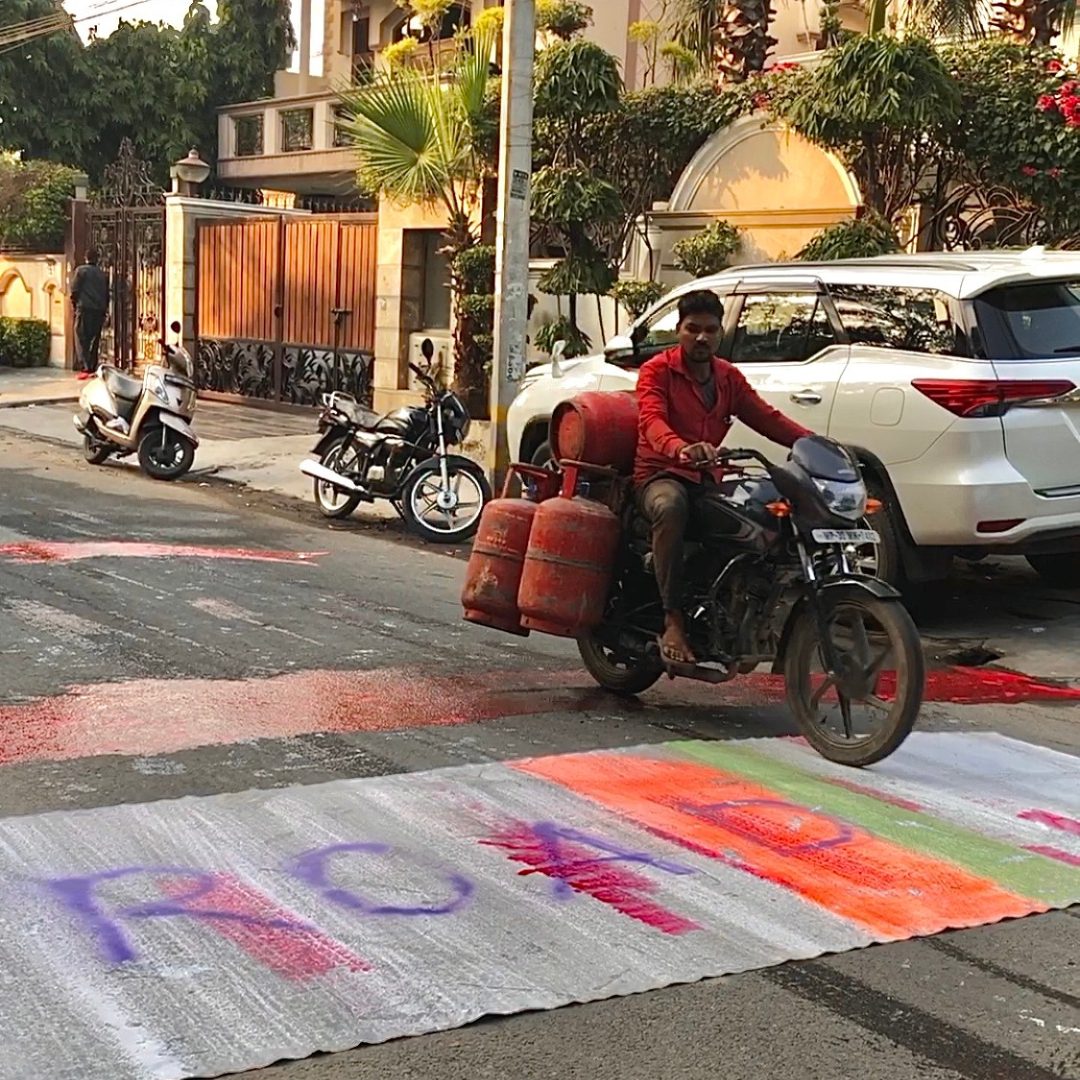
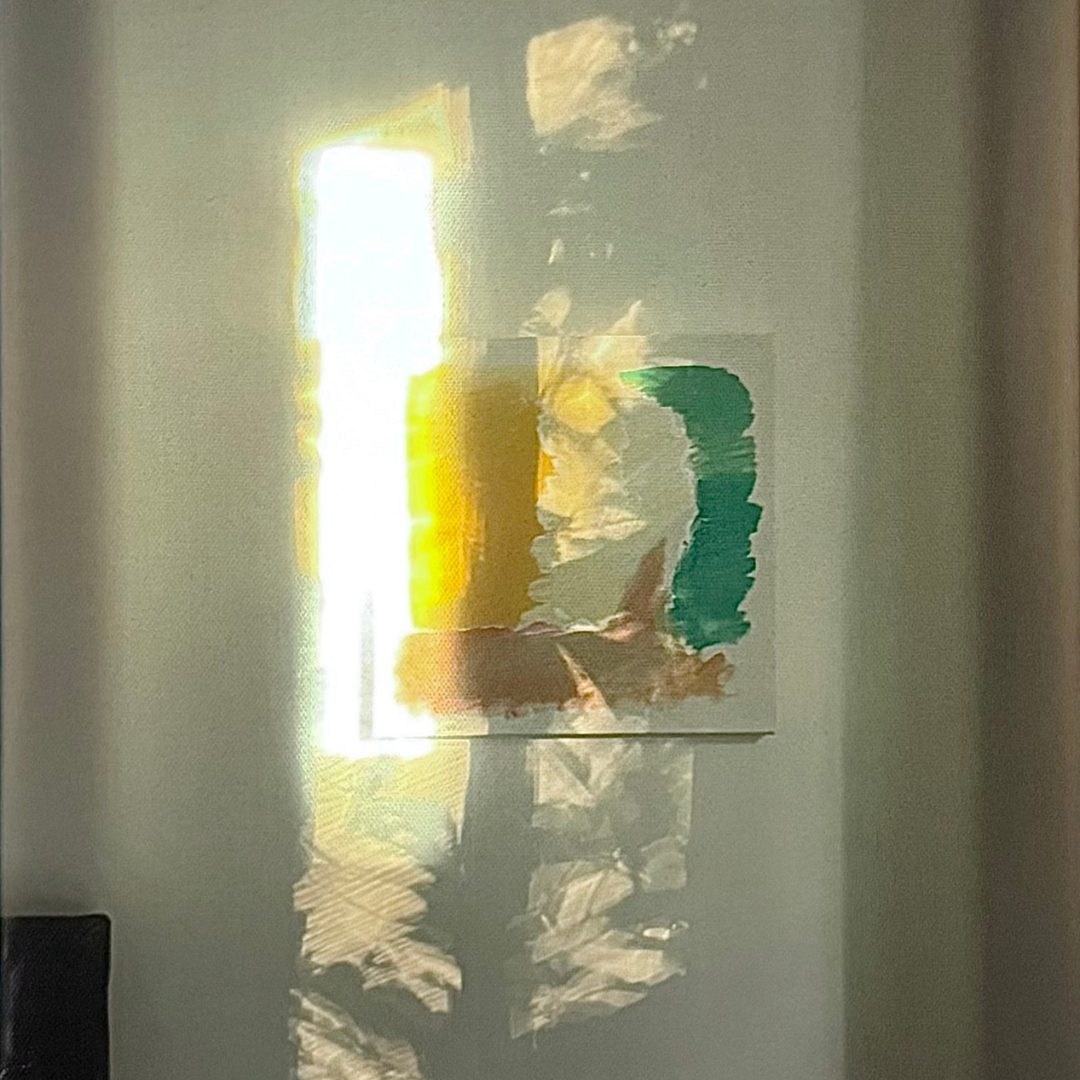
There are two works that feel particularly significant to me, each for different reasons. One changed the trajectory of how I approach my practice, and the other shined bright (literally) through challenges and uncertainty.
The first work is ROAD (2020). For this piece, I laid a loose canvas on the road with paint around it, allowing passersby to leave marks as they moved across it. This work expanded my understanding of what painting could be and explored questions around authorship, agency, and phenomenology. It opened up a way of thinking about painting as something that could exist through encounter rather than execution.
The second work, The Light Study (2023), developed during a residency in New York. At the time, I was collecting images of sunlight entering interior spaces, forming fleeting shapes as it passed through window panes and met trees outside. I was drawn to the idea that these shapes were not just accidental events, but a form of nature’s art, non-egoistic and quiet, yet holding presence and subtlety.
During the residency, I felt quite lost. I went through many failed experiments with the printed images, and on some days I found myself doing Kakuro and Sudoku puzzles in the studio instead of making work. A visiting artist mentor even suggested that I change direction entirely and look more closely at other artists’ practices to find an idea. Despite this uncertainty, I stayed with the material.
Eventually, the work took the form of an installation. I began using the images as sculptural elements, combining them with artificial light to reiterate the subtle phenomenon that occurs in everyday indoor spaces. The piece became less about resolving an idea and more about allowing attention, patience, and observation to guide the process. It remains significant to me because it holds that period of doubt alongside the quiet persistence that led to its emergence.
I think the legacy I care about most is the conversations or shifts my work create when encountered by a viewer in ways I could never anticipate. Someone once told me that after seeing The Light Study, they were rushing out of their house when they noticed the sun hitting their living room. They paused, remembered the work, and felt a moment of calm. That kind of pause feels more meaningful to me than any fixed interpretation.
On a more personal level, I hope my legacy includes what I learn along the way and how I am able to share that with younger creatives. Choosing art as a way of living takes courage, especially when it means stepping away from predictable paths. It hasn’t been easy for me, and I know it isn’t for many others.
Because of that, I believe deeply in support, collaboration, and dialogue. If my work or experiences can help make that path feel less isolating for someone else, or encourage even one person to allow themselves to be their creative self, that would feel meaningful to me.
Finally, looking ahead, what kind of legacy do you hope your work will leave — either in the art world or more personally?

Do you have your own breakthrough moments to share? We want to hear from you! Email hello@visual-artists.org for more about our Artist Profiling Service.
Artist Breakthrough Moments: In Conversation with Calder MacKay
Guest Written by Lola George Hammerton
University of Liverpool Student