
An Interview with Trevor Burgess: Best International Artist for VAA Artist of the Year 2025 and February Member of the Month
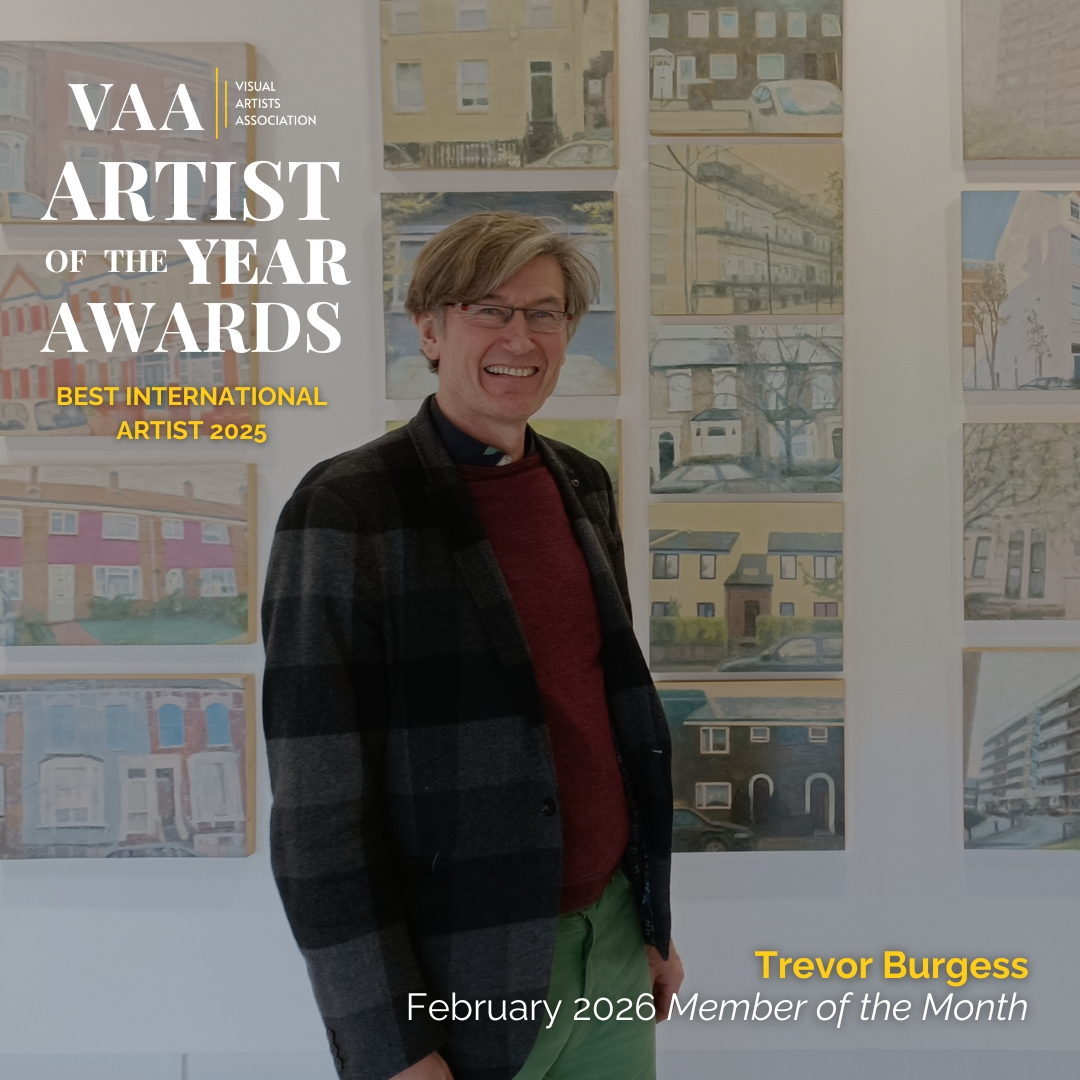
Trevor Burgess – Artist Feature – VAA Member of the Month February 2026
Trevor Burgess is an artist living and working in London, who throughout his life has been painting to give his memories and experiences some kind of value, form, and permanence. Trevor initially studied literature, going on to train and work as Assistant Curator at the Norwich Gallery for the ‘East’ International exhibit. Having founded and steered the Warehouse Artists Studios in Norwich, where he was based from 1990 – 1997, he was closely involved with the artists-run studio movement and worked with the National Artists Association to launch a Code of Practice for the Visual Arts.
For over 20 years, Trevor’s painting have been a celebration of the city’s multicultural street life and diverse communities. His travels around Europe, Latin America, and India – often painting the cities he has visited – have brought his work to an international audience.
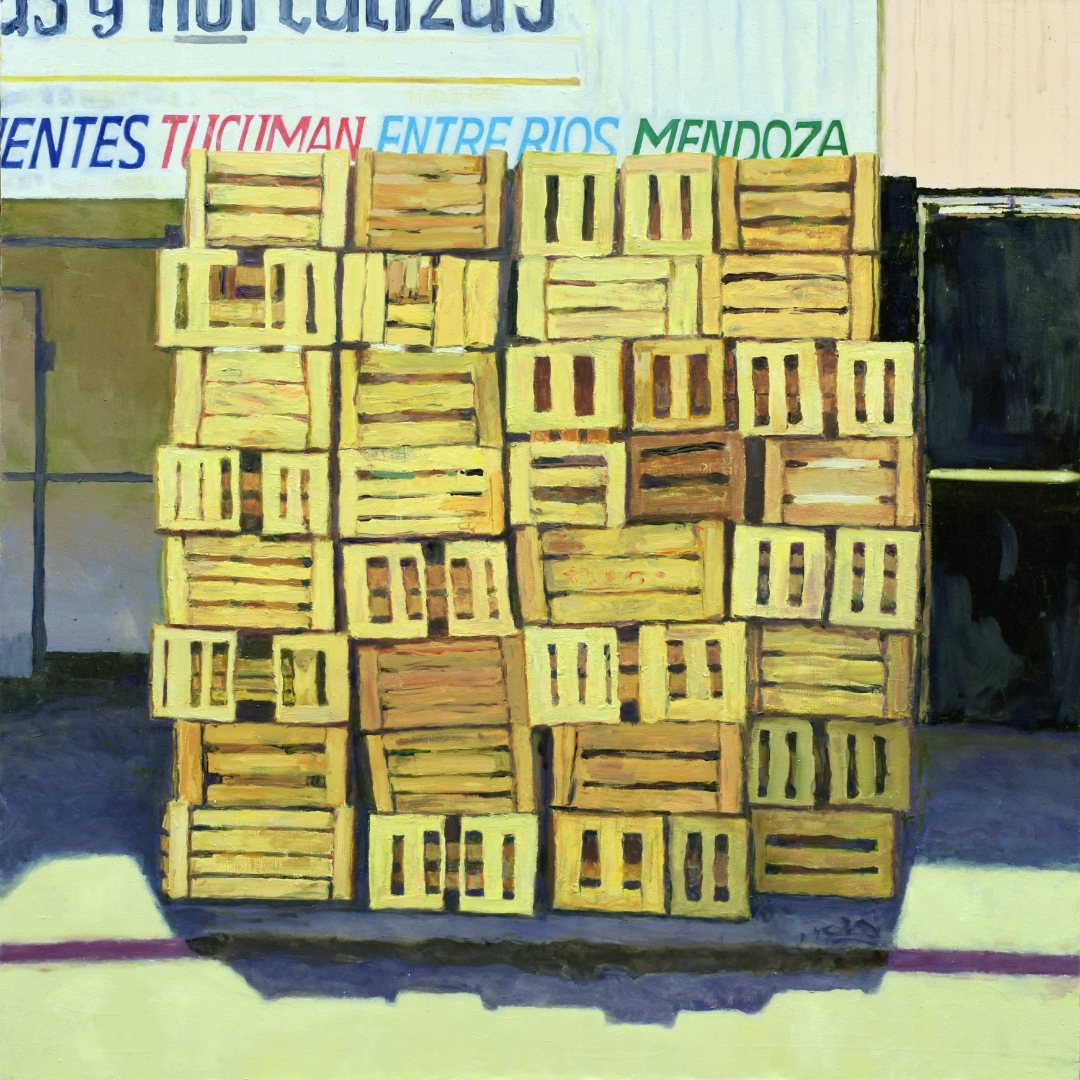
His paintings are often developed in a series around a theme, in which individual pictures reinforce each other when seen together. A recurring theme that Trevor has explored has been market stalls and shops. Most recently in his Stacks and Wrap-up series, he became interested in market stalls when they are wrapped up, shuttered, and closed. Each of the paintings in this series presents a sculptural object set in an everyday context, dominating the canvas the object radiates mystery – what is hidden provokes the imagination more than what is seen.
“For me, the marvel of painting is that it’s a flat surface, made up of colour and yet we see into it, enter imaginatively into the picture and inhabit it.”
Trevor’s days are never typical, having travelled around the world for much of this year. Some of his trips are related to cultural projects he works on with partners, currently on topics including Mentoring in the Arts and a project about Artificial Intelligence and Creativity. Whether he is travelling for projects, or just with friends and family – he is always gathering visual impressions and documentations that feed into painting. With everything Trevor has going on, time in the studio to paint is precious, carving out slots of time to be immersed in his painting. Sometimes this is simply a matter of preparing the materials, musing, spending time with work in progress considering what the paintings need, other times, having a limited period of time – he devotes this to a small painting, as large paintings need uninterrupted days of complete immersion. One goal he has for the year, is to extend the time available to make larger paintings.
In 2024, he was invited by Artist Raksha Patel to curate a large-scale exhibition, Standing Ground: re-thinking the painted British Landscape. It was a major undertaking including preparing the catalogue, supported by British Art Network. The exhibition launched at Thames-Side Studios Gallery, London, having a wonderfully positive reception, Trevor is now arranging the tour for this.
To learn more about his work, head to his website: Trevor Burgess
Or Follow him on Instagram: Trevor Burgess (@trevorburgesspaintings)
“I have so many unrealised paintings in my head waiting to be done, and new projects. Because I tend to think of my work in related series of paintings and like to have specific projects or exhibitions to work towards, I have a backlog of project ideas, some of which may be quite distinct themes. I see them in my head, waiting for their moment.”
I often think of paintings in a series, envisaging them together, related to each other. This has resulted in paintings that explore various themes – castellers, markets, street paintings, a Place to Live, paintings in inverse colour, fruit and vegetables. Underlying them is often a quite specific visual experience. The idea for the Stacks and Wrap-ups, for example, came to me when I saw stacks and piles of wrapped-up produce in a wholesale market in San Juan, Argentina, that evoked for me a large sculptural installation. That’s when I first envisaged making a set of large paintings, which would be dominated by these impressive and mysterious objects. Then I started looking out for stacks and wrap-ups in street stalls and markets after they close in places I visited in different parts of the world. I now have a set of source images that I am slowly working through and adding to as a basis for these paintings.
There have been some key moments in the development of my painting. Going back to when I was at school in the North of England, my art teacher gave me some oil paints and encouraged me to go out and paint the landscape. In my early years, that’s how I learnt to paint. Then I turned to making free improvisatory figure paintings often on themes related to family dynamics. Then, I did an MA European Fine Art in Barcelona, where I was inspired by seeing the custom of Castellers or human towers. For the first time I turned to a book of photographs of the Castellers, to supplement my drawings and imagination as source for making paintings. Before that I had been wedded to imagination and observation and had never used photos as source material. When I came to London in 1999, inspired by the multicultural street life in the neighbourhood where I lived, I began taking snapshot photos that provided me with a whole new subject matter in painting contemporary urban life.
I had the idea for making paintings in inverse colour years before I actually made the pictures. I noted in my sketchbook thoughts about the gap in painting between beauty of the surface of the picture and our habitual capacity to “see into” the painting and enter it in our imaginations. Could these things be pulled apart? The catalyst in this case for making the paintings was the Brexit referendum. I was in a meeting in Brussels on the day of the referendum where a German MEP was speaking inspiringly about the role and importance of culture and the arts at the heart of European identity. Then came the results of the vote that night. Returning to the UK in a state of disillusion and shock the next day, I decided to go straight to the studio and make the first painting in inverse colour. Birling Gap, 26 June 2016 unites my family history and political history in a view of England’s iconic white cliffs, dramatically inversed in colour. Later, the pandemic lockdown had the effect on me that I couldn’t bring myself to paint pictures of busy street life when the streets were empty. In this case, I was thinking of paintings by artists such as Sean Scully or Geraldine Swayne, that were on aluminium, and this seemed to me a suitable physical format for the experience I wanted to create in re-mixing new versions of my previous street paintings in inverse colour.
I am guided fundamentally by trying to be authentic to my memories, feelings and visual experience. Now that I primarily work from photographs, this guides me in finding what I want to paint and how I want to paint it. The photograph is a jumping off point towards recovering my memories and sensations. Making a painting leads me back to experiences I have had in the world. At the same time, a painting is an autonomous being with a life of its own. I try to watch it carefully, and see what it needs. I try to keep open to the unexpected. I have a slightly irrational belief that the paint itself will naturally communicate something more suggestive, complex and evocative than anything my will and control will achieve. As I have got older, perhaps I have learnt how to co-operate better with what the painting wants.
What is your creative process? What outlook guides you?
What is your definition of artistic success?
For me there are two levels of success. The first is that the work satisfies me – the picture comes together and feels authentic and right; the paintings relate to each other; an exhibition coheres as a whole. Sometimes little things in a painting will bug me, and I can’t let the picture go out into the world until they are sorted. Sometimes, I am so close to the painting that I can’t see it properly, and the picture needs time for me to realise what it needs. And with conceiving and hanging an exhibition, there are so many factors that build together to make a successful installation of paintings in a space .
Over the years I have reached a point where I am more able to complete paintings to my satisfaction, but I still have pictures that don’t come together or that I don’t know how to resolve. I have four new paintings this year that I am still reflecting on, and previous work that I don’t consider satisfactory for letting out of the studio. I think I have also become more demanding of what my paintings require. On this level of producing successful paintings, the opinion of other artists whose views I value also contributes. And then, to find that the paintings communicate with people and they respond to them is always very satisfying.
So, success at the level of making the work is fundamental. Without it, external success is hollow and meaningless. Externally, of course, winning a prize or award, and being selected for exhibitions, is affirming, although there is a proliferation of awards and prizes now, some of which are not of high quality, so one has to be selective. On a practical level, I would define success simply as earning enough to live on from my painting, and being sufficiently in demand from curators, collectors and galleries that I don’t have to spend so much time doing my own promotion and marketing and could spend more time making the work.
I have held two solo exhibitions this year showcasing different aspects of my practice. The first, Colour Revolution at Norwich Crypt Gallery, gave an opportunity to see together a series of paintings I have made in inverse colour. The exhibition followed on a talk I gave initially to Leeds Philosophical & Literary Society and then to Norfolk Contemporary Art Society titled What colour is that? – a painter’s notes on the perplexities of colour.
The second exhibition, Paintings of London in the characterful 18th century Town House Spitalfields brought together a selection of small scale paintings of everyday street life in the neighbourhoods I have lived in in the city. It also included paintings from my series, A Place to Live of houses in London, inspired by the estate agent property ads in newspapers. This exhibition coincided with an interview with me by London art critic Tabish Khan in Londonist: Urban Palette where I talked about why London has inspired me to paint over 20 years. Four new small paintings made this summer have been selected for the ING Discerning Eye at the Mall Galleries in November.
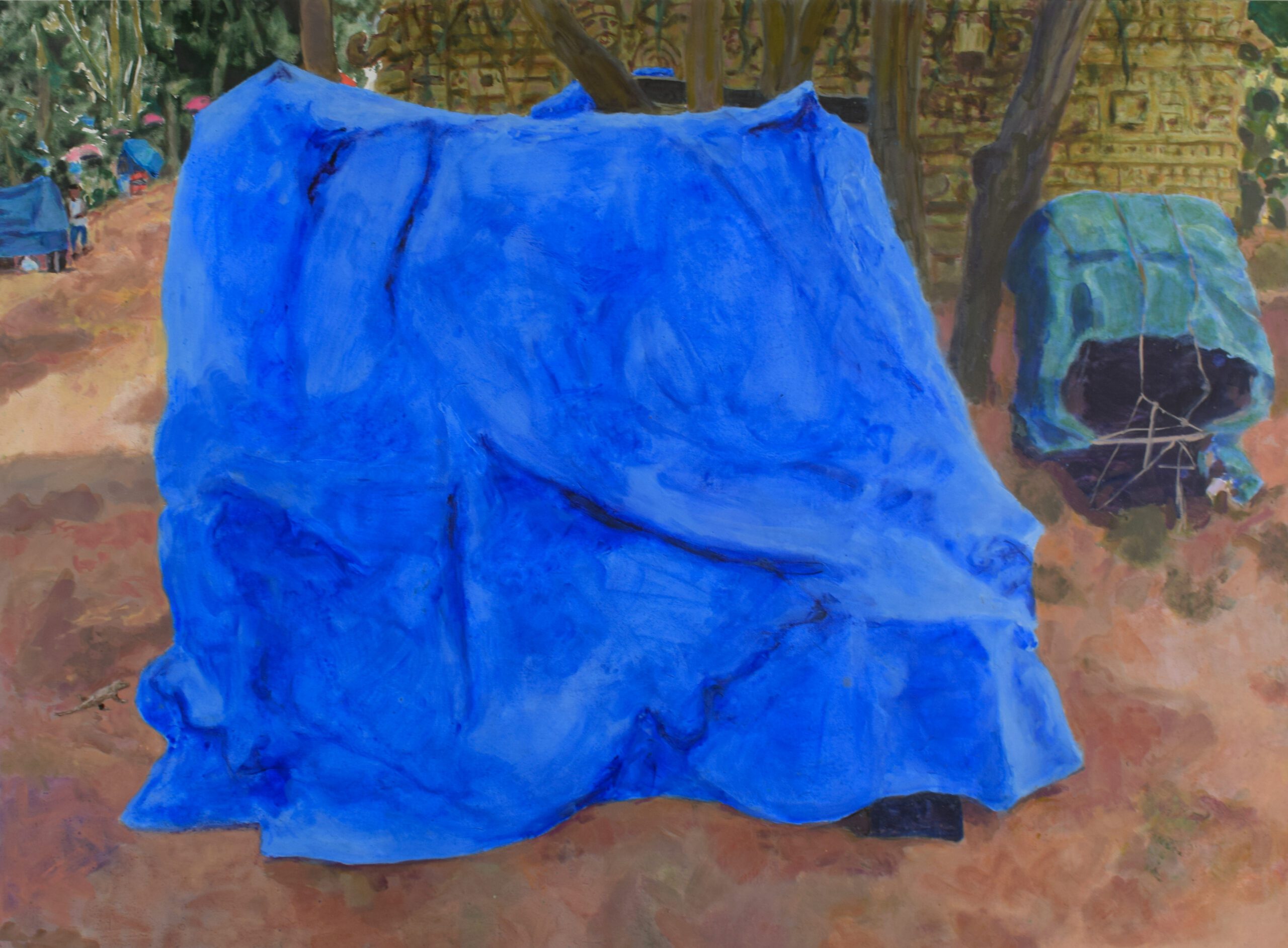
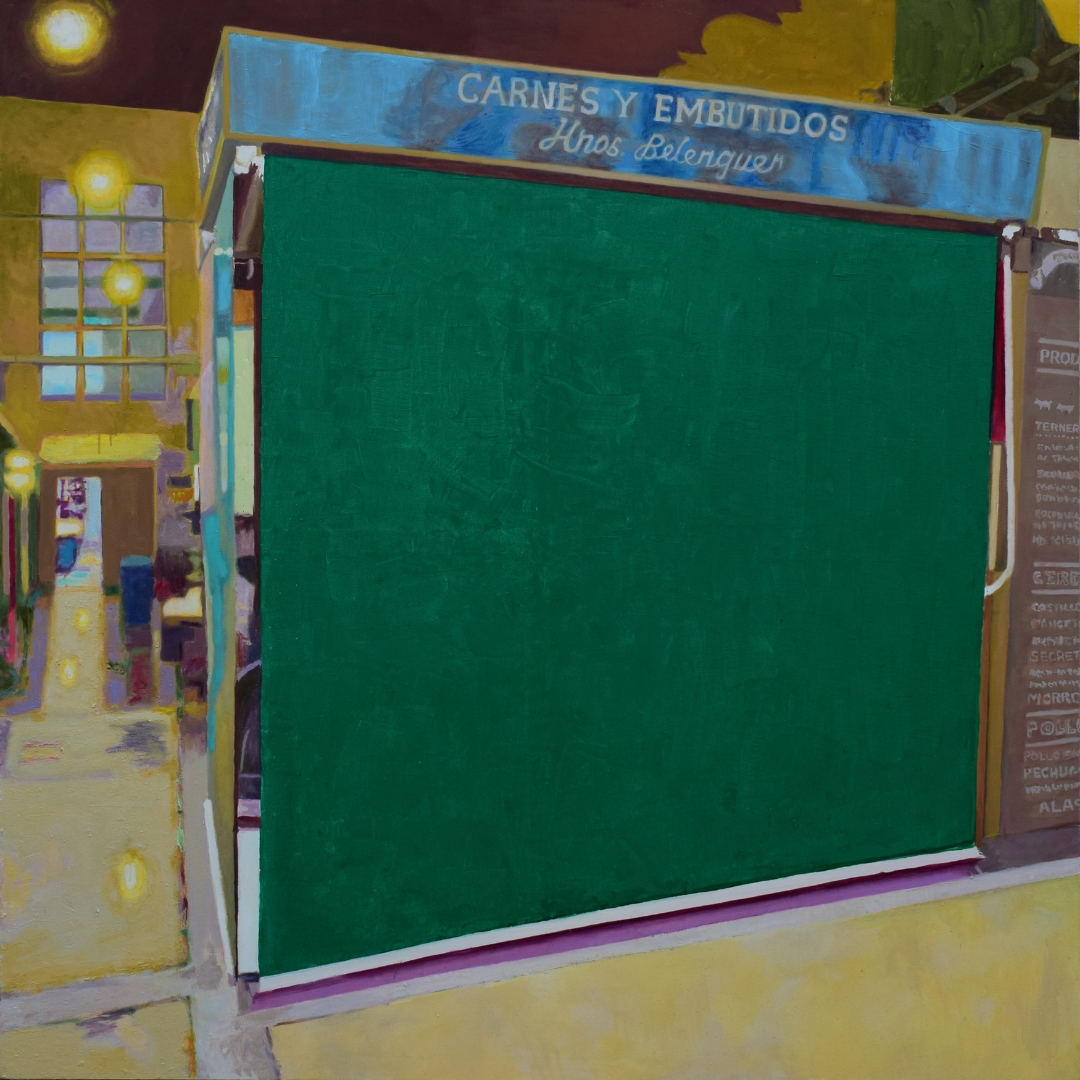
In addition to making new paintings for these exhibitions, I have completed more large canvases for my Stacks and Wrap-ups series, drawing upon trips to Morocco, Yucatan and Paris. One of these, Blue Wrap-up (Yucatan), was selected for a beautiful exhibition, Wells Art Contemporary in Wells Cathedral, which I was very proud to be part of. A second painting from the series, Study for Green Wrap-up (Paris), is being shown in an exhibition, Chlorophilia curated by artist David Leapman at Durdon & Ray in Los Angeles in January 2026. And the icing on the cake for this year has been that another of the Wrap-ups series, Carnes y Embutidos (Valencia) won me Best International Artist 2025 for the VAA Artist of the Year Awards.
For 2026, I have two solo exhibitions lined up. In Autumn, I am showing a selection of the Stacks and Wrap-up series at the University of Murcia in Spain, where my proposal was unanimously agreed by the selection committee. I am planning to make some new paintings for this exhibition. In May, I will also be showing at the South Quay Gallery, Great Yarmouth, I am excited about having both of these exhibitions to work towards this year.
The Stacks and Wrap-up series of paintings are the most ambitious set of paintings I have made. I love making big paintings. These are on a large scale and have a powerful enigmatic presence on the wall. They fascinate me because they can be seen from so many perspectives. On one level they are straightforward depictions of these objects I have seen in the world – wrapped-up stacks of goods and shuttered market stalls. But then they have this aura of being sculptural objects, placed plain centre dominating the canvas, which evoke references to various modern aesthetics that condition how we experience and valorise what we see. Some of them also animate large areas of strong colour, which gives them a material abstract quality and contributes to the strong physical presence of the pictures. And then, they are an international series, based on locations on four continents. Each painting evokes the atmosphere of a specific place in different parts of the world. They take the viewer to these places. They are pictures a viewer can inhabit and be in. Then, also, I cannot be unaware of how they relate to larger economic and political issues over the period I have been making them. The global pandemic that shut down markets, the impact of wars, tariffs, and in my own country, of Brexit, on trade. This set of pictures bring so much together for me.
What are some of the accomplishments you are most proud of? What are some of the highlights from the past 12 months?
What are the biggest obstacles you’ve faced when improving your arts profession? What’s the one piece of advice that has helped you the most?

Painting is a solitary activity. It even uses a different side of the brain to the logical, rational, articulate mind that employs verbal language. So communicating and engaging with people about painting is always challenging. Yet as painters we have to constantly try to put what we are doing into words. I happen to enjoy articulating what I am doing in my painting, I write about my work, have produced catalogues, curated exhibitions and have developed a talk, “What colour is that?” exploring the perplexities of colour from the perspective of a painter, and drawing attention to how looking and seeing is a different category of knowing or experiencing from writing and speaking.
Another significant professional obstacle for a painter, particularly one like me who enjoys working on a large scale, is storing and transporting work. There are constant logistical problems to solve and the madness of Brexit in setting up trade barriers between the UK and the rest of Europe has made things much more complicated and expensive. I sent three large canvases that were selected for the BBA Prize to Berlin last year and the transport was a nightmare not only because of the 7% customs tariffs and paperwork, but also because the pictures are stopped at customs and therefore you can’t simply supervise the loading in the UK, pack and send the pictures direct to the gallery. No, they go into storage with a bunch of customs officials who cannot be expected to treat them with any care, so extra secure packaging is required.
As a result of this, I’m resisting bringing these pictures back out of the EU, and I am looking for exhibition opportunities for them in Germany and central Europe. Any galleries or curators interested, do contact me.
One day the artist John Kiki came to my studio when I was based in Norwich and brought me 50 salad bowls and a can of oil medium. “Try mixing your colours in advance in the salad bowls”, he said. “with 50% medium and 50% turps. Then lay the canvas flat and paint on the floor”. It transformed how I make paintings, enabling me to be much looser, fluid and more improvisational, using brighter colour. And that’s how I have continued making paintings.
My award-winning series of paintings of Stacks and Wrap-ups now consists of 20 large canvases, with more planned. Individual paintings from the series have been exhibited, but the series as a whole has not been seen together and I am convinced this group of paintings seen together in a suitable spacious environment, would make a powerful impact. I am seeking an opportunity for an exhibition to give these works visibility and exposure. Several of the paintings, including “Carnes y Embutidos (Valencia)”, which won the Best International Artist” award, are currently in Dresden, Germany, so I am open to offers to exhibit them in central Europe.
I was completely thrilled and overjoyed to be named Best International Artist in the VAA Artist of the Year Awards 2025. I have entered for many prizes and awards, and like all artists I have learnt to deal with the rejections. My way of managing my expectations has been by never expecting to actually win! So it was really sweet when the prize was announced. The painting that won was also shortlisted and exhibited in the BBA Artist Prize in Berlin last year and it was then featured again when I was one of just five artists from that show in a follow up exhibition at BBA Gallery curated by Mario Bermel. All this has given a welcome validation and confidence.
Part of the prize is a year’s membership of VAA, which includes access to guides and professional resources including professional liability insurance, all of which I am looking forward to benefitting from.
What Career Goal is your current priority? How has the VAA helped your journey so far?
Is there anything you would like to say to the artist you were a year ago?

From time to time, I look back much longer than a year to when I started to paint at school, and I say to that fifteen year old boy, look what am I doing now! I am sixty-two years old. Yes, and I am doing what I dreamt I would be doing – I am making paintings. And I have a lifetime of making paintings behind me, and my head is full of more to do. Yes! It is possible to follow your dream.
Meet Our Members
Clare Hanna | August 2026, Member of the Month
An Interview with Clare Hanna: People’s Choice Award Winner – VAA...

David Moješčík | July 2026, Member of the Month
An Interview with David Moješčík: Highly Commended Artist - VAA...
Cara Roberts | May 2026, Member of the Month
An Interview with Cara Roberts: Best New & Emerging Artist - VAA...